What Are Expanding Reels and How Does Grid Size Change a Slot?
Expanding reels are a slot mechanic in which the visible playing area can become larger during a round, a sequence of wins or a bonus feature. Instead of keeping the same number of rows and columns from beginning to end, the game may unlock additional symbol positions as certain conditions are met. Some slots add extra rows vertically, while others extend the grid sideways by introducing additional reels. The change can affect the number of possible symbol combinations, the way bonus features develop and the amount of space available for special symbols. However, a larger grid does not automatically mean a higher return or a bigger payout. The actual effect depends on the slot’s payout system, the symbols that appear and the rules attached to the expansion feature.
How Expanding Reels Change the Playing Area
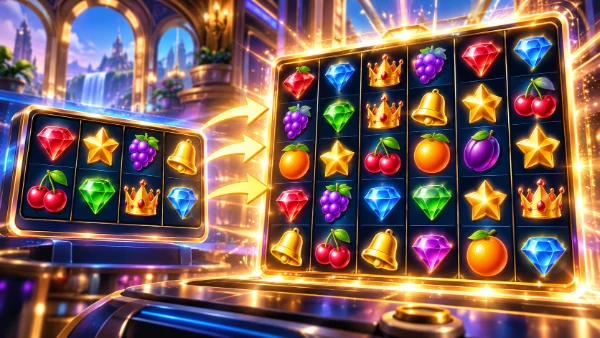
The easiest way to understand expanding reels is to compare the number of active positions before and after the grid grows. A standard five-reel slot with three visible rows has 15 symbol positions. If another row is added, the layout becomes 5×4 and contains 20 positions. A further expansion to five rows creates a 5×5 grid with 25 positions. Horizontal expansion works differently. A five-reel game can gain a sixth reel while keeping the same three rows, producing an 18-position 6×3 layout. Both approaches increase the playable area, but they do so in different directions and can have very different effects on winning combinations.
The expansion usually happens after a specific game event rather than at random visual moments. A new row might appear after a qualifying win, after a special symbol activates or after a particular feature is triggered. In some games, the grid grows step by step during a sequence. For example, the slot might start with three rows, expand to four after one qualifying event and reach five only if another condition is met. This means the maximum layout may be available only during particularly long feature sequences. It is therefore important to distinguish the starting grid from the largest possible grid shown in the game information.
Another important detail is how long the expanded layout remains active. Some slots reset to their original grid immediately after the current sequence ends. Others retain the larger playing area throughout a free-spins round or another bonus feature. Certain designs also keep related progress, such as collected symbols, upgraded values or unlocked sections, until the feature finishes. A grid that remains expanded for several spins can affect subsequent combinations, but that does not mean the same progress will remain once the player returns to the base game. The reset conditions are part of the feature rules and can differ considerably between slots.
Expanding Reels Are Not the Same as Expanding Wilds or Megaways
Expanding reels and expanding wilds are separate mechanics. An expanding wild becomes larger while staying within the existing playing area. For example, a wild symbol may stretch across all three positions of a reel in a 5×3 slot, yet the game still contains the same 15 positions. Expanding reels create genuinely new positions by adding rows or columns. This distinction can be difficult to see when a large symbol fills much of the screen, because the animation may make the grid appear to grow even when its dimensions have not changed. The useful question is whether additional playable positions have been created or whether an existing symbol has simply occupied more of the original grid.
Cascading symbols are also different from grid expansion. In a cascading game, symbols involved in a win disappear and new symbols fall into the empty spaces. This can produce several consecutive combinations during a single round without changing the size of the playing area. A slot can use cascades and expanding reels together, but one mechanic does not automatically imply the other. Some games use winning cascades as the trigger for an additional row, while others keep the grid fixed throughout the entire sequence. The same principle applies to games that display multiple separate boards: unlocking another board is not the same as enlarging the original one.
Megaways slots are often associated with changing reel heights, but this mechanic should not be treated as another name for expanding reels. In many Megaways games, the number of visible symbols on each reel changes from one spin to the next, which alters the number of available ways to form combinations. A conventional expanding-reels feature usually follows a more specific progression, such as unlocking an additional row that remains available until a sequence or bonus ends. Megaways layouts can become larger or smaller on consecutive spins, whereas an expanding-grid feature often represents earned progress within the current round. Some modern slots combine both ideas, which makes it especially important to read the rules rather than relying only on the visual layout.
How a Larger Grid Changes Winning Combinations
A larger grid can significantly increase the number of possible symbol arrangements. Consider an illustrative five-reel slot using a ways-to-win system. If every reel contains three active positions, there are 243 possible full-width position combinations. Increasing every reel to four positions raises that theoretical number to 1,024, while five positions on each reel produce 3,125 combinations. These figures represent potential routes through the reels rather than guaranteed winning combinations. The actual result still depends on which symbols land in those positions, how many matching symbols are required and whether the game counts combinations from a specific starting reel.
More available positions can create additional opportunities for matching symbols to appear, but extra space alone does not guarantee a better payout. Imagine a game that requires matching symbols to appear on consecutive reels from the left. If two matching symbols land on the first reel, three on the second and one on the third, several combinations may be formed from those positions. However, additional copies appearing only on later reels cannot compensate for a missing matching symbol on the first reel. Similarly, a newly unlocked row containing unrelated symbols may contribute nothing to the current result. Grid growth changes the range of possible outcomes, but the symbol distribution remains equally important.
The influence of expansion also depends on the slot’s basic payout structure. In a fixed-payline game, prizes are awarded only when matching symbols appear along predetermined patterns. In a ways-to-win slot, matching symbols can often occupy any eligible position on consecutive reels. Cluster games use another method entirely, requiring connected groups of matching symbols rather than traditional lines. Some collection-based slots use grid expansion mainly to create more space for objects or special symbols instead of directly increasing the number of standard winning combinations. For this reason, the maximum grid size should always be considered together with the underlying payout mechanic.
Different Types of Expanding-Reel Mechanics in Modern Slots
One common design links expansion to collapsing or cascading wins. The game starts with a relatively compact grid, and a qualifying event removes symbols or part of the playing area. After the collapse is completed, another row becomes active. This process can continue until the grid reaches its maximum permitted height or the sequence ends. In some games, ordinary winning combinations are not the only trigger. Special wilds, explosions, feature symbols or other mechanics may also cause the grid to expand. This creates a progression in which the playing area becomes larger as the feature develops rather than appearing at its maximum size immediately.
Another approach expands the slot horizontally by adding new reels. Infinity-style mechanics are a well-known example of this design. Instead of increasing the number of rows, an additional reel may appear after a qualifying combination, extending the grid further to the right. Some games combine this with a rising multiplier or another feature that becomes more valuable as the sequence continues. The expansion and the multiplier should still be viewed as separate elements. More reels provide additional positions and potential combinations, while the multiplier changes the value applied to qualifying wins. A player may therefore see both the playing area and potential payout values increase during the same sequence.
A third design uses expansion as part of a collection or character-based feature. Certain modern slots begin with a fixed square or rectangular grid and include characters that collect particular symbols. Special items can remove barriers, unlock previously inaccessible spaces or enlarge the grid. The additional area may then provide more positions for collectable symbols and feature events. During a bonus round, some games keep the expanded grid and other progress active across several spins. This creates a different experience from a conventional line-based expansion because the purpose of the extra space is not limited to forming more symbol combinations; it may also support collection meters, feature upgrades and other persistent bonus mechanics.

What Expanding Reels Mean for RTP, Volatility and Your Stake
The presence of expanding reels does not automatically increase the overall return to player, commonly described as RTP. RTP represents the theoretical proportion of stakes that a game is designed to return over a very large number of rounds. It does not predict what will happen during one session and it does not mean that a player who wagers £100 should expect to receive a specific amount back. An expanding grid is already included within the mathematical design of the slot. The probability of reaching larger layouts, the payouts available on those layouts and the frequency of the relevant features all contribute to the game’s overall structure.
Grid size also should not be used as a direct measure of volatility. Volatility describes the general distribution of prizes. A higher-volatility slot typically concentrates more of its theoretical return in less frequent but potentially larger wins, while a lower-volatility design tends to produce smaller prizes more regularly. A game with expanding reels can fall anywhere within that range. The fact that the grid can grow from 15 positions to 25 or more does not by itself reveal how often meaningful wins occur. Prize values, symbol frequencies, multipliers, bonus probabilities and maximum-win rules all contribute to the way a slot behaves.
Players should also distinguish between a winning combination and a profitable round. A spin can contain several winning combinations and still return less than the original stake. For example, if a £1 round produces several small awards worth a combined 60p, the game has registered wins but the net result remains a loss of 40p. An expanded grid may create more opportunities for individual combinations without making every sequence profitable. The same applies to bonus rounds. Reaching the largest grid can unlock additional possibilities, yet it does not guarantee that the value returned will exceed the cost of reaching or triggering the feature.
What to Check Before Playing an Expanding-Reels Slot
The first thing to check is the difference between the starting grid and the maximum grid. A game may advertise a large final layout even though most ordinary rounds take place on a much smaller board. Look at what causes new rows or reels to appear, whether expansion happens in the base game or only during a bonus and what makes the grid reset. It is also worth checking whether all newly visible spaces become active immediately. Some games contain locked or blocked positions that remain unusable until another feature removes the restriction.
Next, consider how the slot calculates prizes. More rows can have a very different effect in a ways-to-win slot than they do in a payline or cluster-based game. Check how many matching symbols are required, where combinations must begin and whether special symbols can substitute for ordinary ones. If the game includes multipliers, collections or persistent upgrades, treat these as separate mechanics rather than assuming they are automatically caused by the grid expansion. Understanding how these systems interact gives a much clearer picture of the game than simply looking at the maximum number of visible positions.
Finally, keep the financial side separate from the visual progress shown on screen. A grid that is close to its maximum size can create the impression that an important result is approaching, but previous losses do not make a future win more likely simply because the layout looks developed. If an expanded state is genuinely retained during a feature, the rules will specify what is being carried forward and for how long. Before playing with real money, set a spending limit and a time limit that do not depend on reaching the largest possible grid. Expanding reels can make a slot mechanically more varied and create more complex bonus sequences, but they remain one part of a random game rather than a way to predict the next outcome.